Archive
Twitter and the Internet of Fake Things
 In January of this year, I decided to conduct an experiment on Twitter. I was partly inspired by the Kevin Ashton article: How to become internet famous for $68 and many reports that celebrities had huge fake Twitter and Facebook followings. No one seems to care that they do, although there are dozens of articles “exposing” the whole thing. I found it intriguing that people could actually purchase Twitter followers, Facebook Likes, positive reviews, and retweets. Social Media has sparked all these new markets and I was curious to get the inside story.
My own experiment’s goal was twofold: First, to find out what the real story is on purchasing Twitter followers (because I wasn’t convinced that you could do so) and second, to experiment with purchasing them with Bitcoin. The results of the experiment are interesting, but not nearly as interesting as the Twitterati* itself.
Excerpt from Kevin Ashton’s article: How to become internet famous for $68.
“On social media, it is easy to mistake popularity for credibility, and that is exactly what the fakers are hoping for. To most people, a Twitter account with tens of thousands of followers is an easy-to-read indication of personal success and good reputation, a little like hundreds of good reviews on Yelp or a long line outside a restaurant. Looking online to learn more about somebody has become a reflex—blind daters do it, potential employers do it, potential customers do it.
Specialist social media analytics companies do it too. These businesses claim they can analyze somebody’s social media behavior and accurately evaluate their level of influence.”
Background
On Twitter, it’s all about how many followers you have. It’s also about what you tweet to your followers. The theory is that you’re supposed to carry on 140 character conversations with your followers and fellow tweeters for entertainment and edification. Everything works in theory, doesn’t it?
Twitter has become one of those forums where speakers (tweeters) want to speak but not listen. It’s much the same as in any other forum, digital or physical.
I’ve found that Twitter has very little to offer outside of reading marketing bytes, automated tweets, or rancid dialog from those who disagree with what I’ve stated in an article or in a post. Occasionally, there are those who carry on a constructive dialog, but they are very few and far between. Some tweeters simply tweet just to tweet. It’s analogous to hearing your own voice. It’s both self-medicating and self-satisfying.
And perhaps the most entertaining of all is those who hide behind cryptic pseudonyms. They wish to remain anonymous because they want to tweet things that they’d never say in person. Refer again to my earlier digital graffiti reference.
Experiment Part I: Buying Twitter Followers
I researched the process and decided to try it for myself to see what happens when one purchases Twitter followers and to see if it was truly a scam or not. Spoiler Alert: You can purchase Twitter followers but you might not want to because a lot of them are fake.
I began my quest on January 8 with my own, organically grown 2,761 Twitter followers.
I found some fiverr.com** sellers advertise Twitter followers for $5. For that $5, you can purchase anywhere from 100 to 5000+ Twitter followers, depending on your “vendor.” Some vendors go so far as to advertise “Real” Twitter followers to differentiate themselves from those who sell you fake followers, also known, in some cases, as “Eggs.”
I started out by purchasing a batch of 5,250 followers who were guaranteed to be real.
So my goal from that purchase was 8,011 followers. It took a couple of days for the “delivery” but it finally happened. As if by Internet magic, 5,000 or so followers were now in my tank. I had more than the promised 5,250 followers. The reason is that when Twitter finds fake followers, it deletes them. I’m sure it’s done by some automated algorithm that scans the site for “Eggs” and user accounts that have never tweeted at all.
I was so excited by this, that I had to try again. This time, I went for a whopping 5,550+ followers for just $5. What a bargain. Sure enough, in about a day, I had another 5,000+ followers. Unfortunately, while waiting my total had gone down to 12,959 by January 11. By January 13, it was 12,823 and by January 15 my band of loyal followers had dropped to 12,730.
The 5,500+ followers were advertised as: 100% Real, No Egg Emage (Image, I assume), Fast Delivery, Full Customer Support. It was fast, for sure. In just a day, I had 5,000 more followers to my name. And I didn’t have to setup automated tweets or battle it out with the Twitterati to get them. Such a deal at only $5.
I thought to myself, “Wow, this is easy and cheap. I’ll just keep doing it.” I ordered up another ‘3,000 Real Active Twitter Followers in just 12 hours.’ Yep, just as advertised, by January 16, I now had 15,983 followers. By the 17th, I had 15,931. I stopped counting on January 20th at 15,604.
I then tested my numbers at: http://www.twitteraudit.com.
To my surprise, I found that roughly half of my ‘Real’ followers were in fact fake.
You can only imagine my reaction to this. I kept watching my total number of followers go down every day, sometimes by more than 100 followers. I was devastated. To think that I paid good Bitcoin for those followers and half (or more) were fake.
Just out of curiosity, I checked the following accounts for fakes to see how I fared in the fake Twitter follower realm.
- Charlie Sheen @charliesheen 40% (3 million+) fake
- Bitcoin @Bitcoin 23% (6,857) fake
- Chelsea Handler 43% (2 million+) fake
- CNN @CNN 54% (4 million+) fake
- Wall Street Journal 40% (900K+) fake
- Dwight Howard @DwightHoward 47% (2 million+) fake
So, a full month after purchasing all those Twitter followers on February 17, I had 14.8K followers. I purchased another 3,000 from one of the people I’d purchased from before to see if she had another 3,000 100% Real followers to send my way. Sure enough, she did. She said my target follows would be 17.8K. In about a day, I had just over 18K followers. They always give you more because, as I explained earlier, the blatantly fake ones get deleted.
As it stands now, two months after my original purchase, I have 17.4K followers. According to twitteraudit.com, I have 50% fake, which would give me 8,600+ real followers. According to another auditing tool (http://fakers.statuspeople.com), 63% are fake, 24% are inactive, and a whole 13% are real. Calculating just the real from my current number of 17.4K, that leaves me with a total of 2,262 real followers.
But wait. I started with 2,761 organically cultivated followers. And now, I have as few as 2,262? What’s up with that? One can argue that some of my original ones were fake, maybe a few dropped out, or maybe something is wrong with the algorithms to calculate the totals.
Another tool at: http://www.socialbakers.com/twitter/fakefollowercheck tells me that I have 25% fake or suspicious, 0% inactive, and 75% good. So, who knows for sure?
Experiment Part II: Buying Stuff with Bitcoin
I really don’t like Bitcoin or bitcoin or however it’s supposed to be written. Sorry, the proper terminology for it goes into the “Who Cares” bin. However, for my test, it was the perfect solution. I could purchase something fake, or potentially fake, with something that is borderline illegal. But that’s another story. For the purpose of this post, I’m going to focus on my purchases with Bitcoin.
Remember that standard gigs on fiverr.com are $5.
Here are three of my Bitcoin transactions with fiverr.com:
- -0.00786 BTC
- -0.007965 BTC
- -0.00828 BTC
You see, each time you buy something with Bitcoin, the amount changes because the “value” of Bitcoin constantly changes. Unfortunately, not always in your favor, as you can see by mine. There is also a small fee for carrying out the transaction. I’m not sure how much it is in Dollars or Bitcoins because I didn’t pay a lot of attention.
The problem is that if you use Dollars to pay for something and the amount is $5, you pay $5 on whatever day it is. Not so with Bitcoin. As you can see, I paid three different amounts of Bitcoin each time, although the value of the transaction was $5. Well, $5 in Dollars, that is.
This is one of the strongest arguments against Bitcoin. You don’t really know how much you’re paying because the value fluctuates so much, so often that you can’t track it and there’s not a single exchange value for Bitcoin. So, your favorite exchange might value Bitcoin at $500, while another exchange values it at $450.
One day you might barely be able to buy lunch with a certain amount of Bitcoin and the next day you could buy the restaurant with that same amount. Weird, huh?
I still don’t see the point of using it for transactions because of that point. There are many others, but again, that’s another story.
The jury (literally) is still out on Bitcoin. If I were a betting man, I’d say that the Federal Government or InterPol will shut down all Bitcoin and other cryptocurrency transactions in the near future. And if you think that Silk Road and Mt Gox left people feeling the pain, just wait until Uncle Sam decides that Bitcoin is not only shady but illegal.
Lessons Learned
You might believe that purchasing Twitter followers has left me with a less than enthusiastic endorsement of the practice, but it hasn’t. I think that growing your following organically is the best thing to do. It’s the most honest thing to do, for sure. But hiring “shills” is nothing new to the business scene. It’s actually a very old practice. People, by their very nature, are crowd followers. If you see that someone only has 100 followers, you’re not as likely to follow as you are if that same person has 150K followers.
It’s just the way we’re made. Do I believe that everyone I’ve listed in the examples above have “plumped” their following with purchased or fake followers? Certainly not. The fact is that anyone can buy followers for any account. If I wanted to, I could purchase 5,000 followers for a Twitter account other than my own. That part might surprise you. If you don’t believe me, I’ll buy someone, maybe you, 5,000 Twitter followers. There’s not much you can do about it.
You can buy a subscription to a service that will delete them. But what if they’re wrong? What if they delete real ones that are simply inactive? It’s a dilemma, for sure.
Unlike Kevin Ashton, and who knows who else, I only spent $20 to test this idea of purchased fame. I think the $20 was well spent. It gave me fodder for this post and a bit of entertainment as well. Can’t go to a movie and buy a Coke and popcorn for $20.
Do I think it’s a good practice to buy Twitter followers or Facebook Likes or any other form of fake fame? No, I don’t. It’s kind of silly, really. But, I wonder, is it really all that different than having a Publicist strategize a “chance” photo shoot of a celebrity doing something in public? Is it all that different than running a commercial on TV or sending out a Press Release? Or filming a music video where the artists lip sync while thousands of screaming fans look on?
I think the best practice is to grow your audience, attract your Facebook Likes, acquire multi-star ratings on Amazon, and gather +1s on Google+ by doing something well. That seems to be good advice.
However, in the grand scheme of things, who really cares how many Twitter followers someone has, fake or otherwise? I really don’t care. If you’d have told someone, even you, 20 years ago about Twitter, you’d have laughed a part of your anatomy off. It’s really a silly thing. Social networks in general are silly. Facebook is silly, Twitter is silly, and so on. LinkedIn is pretty good because it’s professional and you can actually measure its value but it’s the exception.
So many people use bots and automated tweeter software that everyone is tweeting but not that many people are reading. Twitter users tweet about everything and they expect that someone is reading their stuff but it really just goes into the electronic aethers to compete with all the other bots and automated quips, fluff, and “sage” advice.
This was an experiment for me. The greatest lesson that I’ve personally learned from it is that Twitter, Twitter followers, Facebook Likes, and Bitcoin only have value if you give them value–or if “everyone else” gives them value and you join in. On their own, they have none.
Now, how much will it cost me to get rid of the fake Twitter followers? Adding followers is easier than getting rid of them. There are services that want to charge you to do this but I think I’ll just wait it out and let Twitter Darwinism take effect. There is a person on fiverr.com, oddly enough, who’ll remove 500 fake followers for $5. So, it costs $20 to buy 15K followers and $150 to remove them. Not a chance.
*People who use Twitter, often as their own platform. Think digital graffiti artists.
**fiverr.com supports sellers of all kinds of “gigs” as they call them. From voiceovers to art to music and, of course, Twitter followers. The site is legitimate and most of the sellers are as well.
Related Articles:
I Bought 27,000 Fake Twitter Followers—and Then Twitter Zapped Them Into Oblivion
Staying Secure in the Cloud: Four Tips for Midsized Businesses
 Working in the cloud can be risky business but it doesn’t have to be a show stopper. What you have to understand is that there’s risk with anything you do and the cloud is no different. You have to manage your risk with intelligent security measures and accept a certain amount of risk that comes with doing any kind of business online. Risk is part of doing business–in the cloud or not.
“IBM is an industry leader in IT security. IBM and IBM Business Partners offer a complete package to fit the needs of midmarket organizations. From cloud computing and big data management to mobile technology and social networking, IBM security offerings allow midsize companies to assess, plan, deploy, and use effective security solutions for their businesses.According to analysts, no other company has the depth and breadth of IBM’s knowledge and experience for security solutions. Few service providers offer end-to-end identity and access management solutions that can address various requirements with a complete set of solution elements that encompass hardware, software, design and implementation, and management services.”
As someone who needs to protect your midsize business, security is important but often elusive and “black box-like.” Your business needs to find new ways to provide security for data, mobile, and cloud computing environments. For more information on how to acquire the industry’s best and most acclaimed security solutions, connect to: http://ibm.com/midmarket/us/en/it-security.html and download the IBM X-Force 2012 Trend and Risk report.

This post was written as part of the IBM for Midsize Business program, which provides midsize businesses with the tools, expertise and solutions they need to become engines of a smarter planet.
I’ve been compensated to contribute to this program, but the opinions expressed in this post are my own and don’t necessarily represent IBM’s positions, strategies or opinions.
Photographer’s Holiday Gift Guide 2013
 If you have a photographer in your life, then this gift guide is the key to his or her happiness this holiday season. No photographer, amateur or professional, has everything he or she wants. There’s always some light, lens, or gadget that’s missing and she’s just never taken the time to buy it or it slips her mind until there’s a special need. You can fill that void with these ideas but first there’s something you have to do.
You have to listen to and observe your photographer. What subjects does she shoot? Does she only photograph people? Does she only work outdoors? Does she like to create short films? Does she ever work with film or is she a digital only type? Does your photographer ever take pictures with her phone? It’s a real thing called Phoneography and there are a lot of apps and accessories available for it. Ask a few questions. It won’t kill you to find out a few details before embarking on a shopping spree.
And you have the choice of enhancing your photographer’s equipment list or expanding it in a different direction. For example, if your photographer only shoots outdoors, you could buy her some studio lights and backdrops to give her a chance to try some portraiture or product photography.
If she’s a digital only shooter, you should buy her an old school film camera and let her creativity flow. Yes, lots of people still use film. In fact, more people now use film than ever before and there are some really cool ones available that extend your sight beyond the normal.
Here are the “goto” websites that you need to know for photography gear, cameras, lenses, and accessories.
Adorama: http://www.adorama.com
I’ll go out on a limb here and say that most serious photographers know about Adorama. It is the primary goto site for all things professional or prosumer, a term that means a high-end consumer who might be a part-time freelance photographer or someone who uses professional equipment. Although bent toward the professional, your up and coming amateur can benefit from better lighting, a higher quality tripod, or a new telephoto lens.
There are shopping tabs on the site that direct you to products that fit your budget or those oriented toward him or her. For example, there are tabs labeled Under $50, Under $100, Under $200 up to Over $500. You can also purchase Adorama gift cards from the front page. Trust me when I say that you’ll see a happy face when your photographer opens an Adorama gift card. A gift card is a great idea, especially if you have no clue as to what your photographer wants or needs.
There are also tabs that are product specific, such as Studio & Lighting, Cameras, Tripods, Lenses, etc.
Great sound is essential for movies, great lighting is essential for photography. Adorama has lighting. It has studio lighting, outdoor lighting, reflectors for natural lighting, flash lighting, continuous lighting, and just about everything any photographer or movie maker needs.
There are two lighting products in particular that I want to bring to your attention: Flashpoint 14″ Fluorescent Dimmable Ring Light and the Glow HexaPop 20″ for portable off camera flash – R Series.
My Flashpoint 14″ Dimmable Ring Light Review gives you a lot of good reasons to choose it for a portrait light. If your photographer needs a source of continuous light for portrait photos, product photos, short films, or stop motion films, this is what you should buy her. Currently, the Ring Light costs $140.00 with free shipping. Buy a replacement bulb for $15.95 and a stand for $25.00 to round out this full lighting solution.

The Glow Hexapop Diffuser shown on stand and with flash unit.
The other interesting lighting gift idea is the 20″ Glow Hexapop Diffuser. Though I haven’t posted my Hexapop review yet, I can tell you that I’ve worked with it and I like it. It is extremely portable, lightweight and it does a great job of providing soft, even lighting from a flash unit.
Ordinarily a flash unit sits atop your camera in what’s known as the “hot shoe.” This is an electronic interface that’s timed with the shutter button so that the flash fires as the shutter opens so that your subject receives enough light to be photographed. Unfortunately most flash units are overpowered and flood the subject with bright, harsh light that is neither flattering nor even.
The Hexapop diffuser does. To use the Hexapop, your photographer needs to have her own flash unit (most do) and a flash sync cord (again, most do). If your photographer happens not to own a flash sync cord, get one at least ten feet long and one that’s compatible with your photographer’s equipment.
The Hexapop is sort of a hybrid softbox and umbrella combination that photographer’s use for studio lighting. Unlike studio lighting, the Hexapop can travel with the photographer without the need for external power. It comes with its own tasteful black carrying case that makes it extremely portable for the photographer on the move.

The Glow Hexapop Diffuser ready to open or to drop in the bag for easy transport.
It sets up quickly and easily by pulling the arms into place and it folds up even faster with a “Pop!” by pressing its release triggers.
Adorama has everything for the photographer and photography enthusiast. For the truly budget conscious, there’s a Deals link that you should check out for Specials, overstocks, refurbished products, and used equipment. Adorama offers free shipping within the USA on many products.
Lomography: http://www.lomography.com
Lomography is an online presence, it’s a store, it’s a movement, it’s a place for you to show off your lo-fi photography, it’s an online magazine, and it’s something kind of unexplainable. Lomography is film and cheap cameras. I should put cheap in quotation marks because some of them aren’t so cheap at all. I guess cheap is relative. You have to love film, its unexpected qualities, its artistic value, and the feeling that you’re going against the grain of the “digital revolution.”

The Holga 120N Camera.
There’s no wrong answer or wrong way to do anything in the world of Lomography but you have to have a lo-fi lens or lo-fi camera to do it. If you want to know more about it all, you can read up on the history and the movement on the website. Just know this: Lomography is addictive and once you start, you want to experience every type of camera.
For example, the medium format (120 film) cameras are kind of my favorites. The negatives are large (generally 2″ x 2″) and you only get 12 or 16 photos per roll. Using one of these plastic gems is not an exact science but it’s really fun. Great examples of medium format lo-fi cameras are: Holga, Diana, and Debonair (the look of a Diana but the operation of a Holga).

The Debonair Camera
My own collection “lomo” cameras include the Smena (Russian), the Holga, the Diana, half-frame cameras, Canon AE-1s, and others. But my most favorite of all is the Debonair. It’s a super cheap little camera that uses 120 film. See photo.
You can find them on ebay.com for under $20. They are cheap, plastic cameras that have a very simple focusing mechanism, a manual film advance, and your creativity to power them. Awesome.
For someone who isn’t into Lomography or just wants to try it, the Debonair is a great starter camera. If you can’t find one, buy a Holga. You can find Holgas everywhere and they come in a variety of colors and styles but only two film sizes: 120 and 35mm. The Holga 135 is the 35mm one. Holgas generally cost under $30 for the standard black 120 film version. You can find film for it online or in camera shops. Use color print film C-41 process because Black and White film is getting harder to find a developer locally. Good luck if you like B&W, like I do. Use color, have the developer scan them onto CD for me and then I use a photo manipulation program to change them to grayscale. It’s almost the same. Plus you can alter the contrast that way too.

The Classic Diana updated with interchangeable lenses and more durable construction.
Once your photographer has caught the bug, you can buy her a Diana, or a 35mm Smena, or one of the more exotic cameras such as a Sprocket Rocket, an LC-A, or a Lubitel. They all have their quirks and interesting features. In fact, no two Holgas are alike, so explore the possibilities with more than one.
Photojojo: http://www.photojojo.com
Photojojo is the Phoneographer’s paradise. It has everything cool for the Phoneographer: lights, lenses, carrying cases, ideas for DIY projects, and all sorts of off the wall products.
I personally bought the three lens set for my iPhone from Photojojo. I love them and they work perfectly. Photojojo also sells some Lomography accessories too. You can also buy film, tripods, microphones, a film scanner, props, a dolly, and just about every kind of oddball thing you can imagine and a lot that you can’t.
If nothing else, Photojojo is worth a look just to see what’s out there for the phoneography nut in your life or perhaps for yourself. Photojojo offers free shipping on orders over $50.00. Often this is not easy to do because most of their items are under $50.00. I guess that’s so you’ll buy more stuff. That’s OK because I’ve never been bummed out about anything that I’ve purchased there.
Amazon: http://www.amazon.com
Amazon has a lot of the photographic equipment, cameras, and accessories that you want and at the prices you want to pay. It has an excellent search engine and if you’re a Prime member, then you get free priority shipping on anything that is Prime qualified. Look for the Prime symbol  when you find a product that you like.
Sometimes I use Amazon just as a sanity check against other online retailers. I also use it to see if I can get the products I want with free shipping, because I’m a Prime member. I don’t want to take anything away from the other retailers in this list or any other but if I can find the exact product on Amazon with Prime at a comparable price, I’m going for free shipping.
If you can’t figure out what you want to buy or you need a little extra advice, I’d be glad to help out. Drop me a line at ken-at-kenhess-dot-com (replace the at with @ and dot with . and don’t use the dashes. I have to do this to confuse email bots–sorry) and I’ll see what I can do for you.
Screenwriters Unite and Discover WriterDuet
 WriterDuet
WriterDuet.com
Collaborative Screenwriting Site
Free
[This post is a product spotlight and not a review]
FADE IN:
Guy Goldstein has created one of the best screenwriting tools that I’ve ever seen and used. I’ve used several: Celtx, Final Draft, Microsoft Word with Screenwriting Template, and Sophocles, to name a few. One of the cool things about WriterDuet is that you can collaborate in real-time with someone else on a script. You can immediately see updates, chat, share ideas, and more. This means that your writing team no longer has to all be in the same room or on the phone trying to fumble around with some white board or screen sharing program.
WriterDuet has an easy to use, intuitive interface that gets you going fast. You really need almost no experience with screenplay formatting to use it–it helps but it isn’t absolutely necessary.
And Guy listens to his users. I wrote him that I’d love to have the ability to create an outline and have a place for notes. He created it within a few days and emailed me back for feedback. The new tools were perfect and exactly what I was looking for.
It’s a true collaborative tool that I’d recommend to anyone who writes scripts alone or in a group. To me, WriterDuet is like the WordPress of screenwriting: easy, unencumbered, and free. Well, it’s like WordPress with one notable exception: Guy responds to his emails. So, there’s that.
To see WriterDuet in action, check out the video below and meet Guy Goldstein face-to-face (virtually speaking).
 As you can see from the image (right), the interface is clean and ready to help you on your way to screenwriting success. There’s a built-in spell checker, all the screenwriting features you need such as parentheticals, actions, dialogues, character, and more. If you don’t want to type, you can click the microphone icon and speak your script to get a feel for how your dialogue sounds as it’s written to the screen.
You can download your scripts to PDF format or into a variety of other popular commercial screenwriting tool formats. There’s also an option for uploading your scripts so that you can collaborate on them.
So, what more could you want from a cool screenwriting tool? Well, how about an offline version? You know, a standard, installable software version of this great tool. That’s exactly what Guy is working on now. He’s started a Kickstarter campaign to help fund it.
If you decide that you like WriterDuet and that you’d like an offline version, please go to his Kickstarter page and help fund it. Or if you’d just like to help out a young man realize his dreams in exchange for a few dollars, I’m sure that he’d be OK with that.
Personally, I love WriterDuet. I love its professional design. I love its simplicity. I love its price. And I love the fact that Guy is trying to make this incredible tool even better by creating the offline version. I think that WriterDuet is the perfect screenwriting tool and its enhanced features (collaboration, notes, chat, voice chat, voice dictation, downloads) make it even better.
FADE OUT:
How a Managed Service Provider Can Help Your IT Career Hit the Big Leagues
[Contributed article by Patrick Zelten]

There is a saying among baseball players in the Dominican Republic that “No one ever walked their way off the island.” It’s used to explain why players from that region are such “free swingers.”
While conventional baseball strategy might dictate that you only swing at good pitches, and that a walk is as good as a hit, players from the Dominican Republic know they may only get one chance to impress a Major League Baseball (MLB) scout and get signed to a contract that will get them off the island and to the USA. And the only way to impress those scouts is to hit the ball hard. So they pass on doing what’s expected in order to focus on doing something that will get them noticed.
That’s an approach ambitious IT managers should embrace when it comes to how they spend their time. However, typically the majority of their time is spent keeping the lights on – i.e. performing all the routine maintenance tasks that keep current hardware and software running smoothly. In fact, according to Gartner the budget is broken into two parts — continuing IT operations costs or “keep the lights on” money (circa 65%), and new projects for business improvement and change (circa 35%). Source: Gartner CEO Advisory: Three Changes You Can Make to the Way IT Innovation is Framed, Mark Raskino, Jackie Fenn (28 June 2013).
It’s important work. Perhaps even mission-critical in some respects. Yet it’s also what’s expected, mere table stakes. In fact, you might say that while letting the lights go off regularly will certainly get you noticed in a negative way, meeting expected service levels—no matter how much skill, time and effort it reflects—will likely do little to advance your career.
To become a superstar within the organization, you need to do something spectacular – something that helps transform the business for the better, or at least delivers noticeable value to it. You need a home run, not a walk. But how can you hit that home run when the bulk of your day is spent monitoring, tweaking, patching and otherwise tending to the day-to-day needs of the organization’s technology?
This is where bringing on a managed service provider (MSP) can help. If you can hand off most of the 65 percent “keeping the lights on” duties to an MSP, you will gain back time for you and your staff to perform more meaningful work. The right MSP can also bring you new ideas that have worked with other companies or in other industries – ideas you can suggest to your management that make you look brilliant. And “brilliant” is definitely a good reputation to have when you’re looking for a career boost.
Striking out the fears
 So why don’t more IT managers bring in an MSP? For many, it could be a misunderstanding about what an MSP is. They may still think of it as 1990s-style outsourcing, where entire internal IT departments were shut down and their functions moved to an offshore provider to drive down costs.
Here in the second decade of the 21st Century, an MSP is not a replacement for an IT department. It’s an enhancement to it.
The objective in bringing in an MSP isn’t to reduce head count; it’s to free those minds to develop the innovations and make the kinds of contributions that only internal personnel, with their deep knowledge of the business, can create in order to add value to the business.
IT managers may also hesitate to bring in an MSP if their performance reviews depend on documenting a high uptime. In those cases, they may feel pressure to take personal responsibility for performing the actual work. Yet the evaluators don’t really care who keeps the lights on, so long as they stay on. By choosing the right MSP, and holding them to a higher service level agreement (SLA) than the organization might be able to commit to internally, IT managers can still meet or even exceed performance goals without having to invest a lot of time in the day-to-day operations that make achieving “five nines” uptime possible.
One other factor that may be preventing the move is concern about a loss of control. IT managers may fear that the MSP will come in and start dictating policy or telling their staff what to do. Yet that’s not the way a proper MSP/client relationship works.
Instead, the MSP should be viewed as an extension of your IT department, operating under the same business policies, security protocols, approval and rule change procedures etc. as internal personnel. It’s still your IT environment. The MSP may make suggestions, but in the end it’s you who makes the decisions.
Going to Bat
Once you’ve decided bringing in an MSP is a good idea, it’s time to go to bat for them; in other words, build the business case. Generally this involves identifying an area of need and showing how the MSP can fill it immediately.
The MSP should be able to assist you with demonstrating the business value. They can help you identify areas of need, develop service level agreements (SLAs) that meet or even exceed your internal department’s current performance and lay out penalties if those SLAs are not met.
For many organizations, the business case for bringing in an MSP is made based on staffing needs. For example, perhaps you’re having trouble finding or retaining the right skillsets to maintain the level of security demanded by the business. You can show how bringing in an MSP that already knows the security technology you’re using can solve the problem faster, and more cost-efficiently, than hiring and training a new internal staff member. After proving themselves with this project you can use it as a lever for other work.
You might also consider using an MSP to provide local (or remote) support for one or more branch offices. As they demonstrate their value the program can grow until they are providing support for multiple solutions, or even the entire organization.
A third possibility is in cases of rapid growth, where it is difficult for the internal department to keep up with technology patches, upgrades, user provisioning and other maintenance-type work. The cost to hire, train and provide benefits for internal resources to meet the peak demand versus bringing in an MSP to fill the gaps will likely easily justify the MSP; once they have demonstrated their value it will be easier to explain how they can take on additional work.
Of course, in the end you have justify the cost by demonstrating the ROI. If the MSP can deliver the service faster and at a higher level than your internal department, that’s great. If in doing so they allow your team to get to other work that improves profitability or creates a distinct business advantage, that’s even better.
Swinging for the Fences
Beyond the what and the how comes the “why?” Why you should make the effort to bring an MSP on board and integrate them with your in-house team? The reason is that there are several ways working with an MSP can help advance your career.
As mentioned previously, the most obvious is by giving you and your team time to do great things instead of spending your days merely keeping the lights on. Rather than punching out a few singles or taking a walk here and there and hoping someone notices, you can really swing for the fences with dramatic projects that have sweeping, long-term impact on the organization.
Beyond that, though, by working with an MSP you’ll gain access to a broad range of knowledge and experience your team may not possess. In their role as consultants, the MSP can offer suggestions on ways to approach a business issue that your team may not have thought of. They will likely be able to help you build the business case by pointing to other successful implementation in which they’ve participated.
An MSP can help drive cost optimization as well by providing focus on your maintenance tasks. For your internal staff, maintenance involves things that have to be done, even though they may not be the most exciting. For the MSP, however, that is their primary focus with your organization, and in order to keep the engagement they must do it well. This focus will help you ensure your environment is kept current with all patches and updates. It will also help you avoid staffing challenges by having a “bench” to call on when the situation requires it. It could even help you lower your costs. Most importantly, though, it will give you and your staff time to focus on areas that are core to driving the business, which will make you look like an all-star to the front office.
The overall impact of these contributions is they show you to be more strategic and less tactical. Which is exactly the impression you want to make when you’re looking to advance your career.
Make It to the Game
 Just as no one ever walked their way off the island in baseball, it’s highly unlikely you’ll advance your career by doing only what’s expected. You need to do things that have a positive, noticeable effect on the business.
Working with an MSP can give you the time, knowledge and resources to make a major league improvement in your organization while helping you move to the top of the lineup for your next job. And that’s a home run in anyone’s book.
Patrick Zelten is the vice president of managed services for Forsythe, a North American IT infrastructure integrator headquartered outside Chicago. He can be reached at pzelten@forsythe.com.
Calling all Technical Authors or Want-to-Be Technical Authors
 The following is a list of book topics for which my agent is looking. Are you an author or have you wanted to be one? Drop me an email at: ken (at) kenhess (dot) com and I’ll fill you in on the details–at least as many details as I have.
Here’s the list:
- Database security
- Cloud consolidation
- Privilege analysis
- Software as a Service (SaaS)
- Database as a Service (DBaaS)
- Back-up and the Cloud
- R Techniques for Big Data
- R programming
- Solaris
- Database and OS administration
- Application consolidation
- Integrating technologies (Database, servers, OS)
- *aaS (Anything as a Service)
- Assembly language programming
- Lambda programming in Java
- Fast Data
- BPM
- SOA
- Middleware
- Enterprise data quality
- BPM for Healthcare
- Process Modeling for Healthcare
Now’s your chance, so go for it. You have nothing to lose. If you’re successful, you’ll have fame, fortune, precious jewels, expensive cars…OK, so you might not have any of those but you might see your book in a bookstore and definitely on Amazon.com. And you’ll be able to call yourself a real author.
Storage Trends and the Future of Storage

Do you see the Infographic to the right? You only see part of it. How much information can you use from what you see now? Not much, right? It’s the same with your storage–you’re only getting part of the story because you’re only seeing part of the picture. Only seeing part of the picture is disturbing enough here but think about what you’re not seeing from your current storage tools.
What do you know about the storage in your company or organization? One thing you do know for sure, without much investigation on your part, is that a lot of the storage you’ve paid for is wasted. Your money’s wasted. Your capacity’s wasted. And all the while, your technology staff’s begging for more storage because they’re running out of space–or at least they think they are running out of it.
Some of it isn’t your staff’s fault. They too, are only seeing part of the picture. It’s your storage management tools, your storage management strategy, and your storage technology that’s causing most of your space waste problems.
But waste is also only part of the picture. How will you manage the rapidly growing volume of data with which you must contend? How efficiently can you retrieve it? Are you still relying on tape and traditional data recovery technologies?
And how about disaster recovery? How many tapes and restore points will you have to manage in case of a major outage? Have you estimated your mean time to restore (MTTR)?
There’s a way to manage your storage environment efficiently, with less waste, with lower power consumption, and with less sprawl. Check out the full The Top Trends in Storage Infographic from IBM to see the solution and get the whole story.
IBM offers a range of Storwize products from Entry to Enterprise.
Five of the many outstanding features of the Storwize family of products are:
- Flash Copy – Make up to 2,040 copies of your data.
- Remote Mirror Function – Copy data to a remote location for disaster recovery.
- Data Volume Management – Real-time compression takes place on data as it is written to disk.
- Visual enhancements – You can easily view your storage capacity, how much you’re using, how much is free, and how much space is saved by compression.
- Lower costs – Easy to manage storage that is space, time, and cost efficient.
The Storwize product line is part of IBM’s Smarter Storage for Smarter Computing solution.
This post was written as part of the IBM for Midsize Business program, which provides midsize businesses with the tools, expertise and solutions they need to become engines of a smarter planet.
I’ve been compensated to contribute to this program, but the opinions expressed in this post are my own and don’t necessarily represent IBM’s positions, strategies or opinions.
Looking at the ROI and TCO of IBM PureFlex Systems
 By a show of hands, how many of you need to know, or want to know, the total cost of ownership (TCO) of your technology investments? Fine. Now, how many of you need to calculate the return on your technology investments (ROI)? Chances are very good that if you raised your hand at either or both of those questions, you’re a company manager, a C-level executive, a project manager, or a marketing representative. You have a vested interest in knowing the numbers behind a technology investment. No one has enough power to make capital purchases without answering to someone for them.
Sure, there are some intangible returns reaped from using the best available technology but subjective value is difficult to put on a graph. It’s even more difficult to explain to shareholders. Perhaps the best way to gain an understanding of ROI, TCO, and value is to use a disinterested third party to give you an unemotional, objective assessment.
IBM understands the value of doing just that. That’s precisely why IBM has enlisted the services of Alinean, Inc. Alinean, Inc. (Alinean) is a company that develops “economic justification tools” for business-to-business (B2B) vendors. Alinean developed the IBM PureFlex System TCO Analysis Tool to compare the total cost of ownership for the IBM PureFlex System versus a traditional dedicated or virtualized IT infrastructure.
To use the IBM PureFlex System TCO Analysis Tool, you’ll need some assistance from your technical team leads. There are questions that refer to server groups, hypervisor type, databases, application servers, storage tiers, and virtual machine configurations that you’ll have to know to complete the Requirements section (tab).
 Based on the information you provide in the Requirements section, the tool calculates the IBM PureFlex Systems equivalent hardware and software requirements and the total cost associated with the transition*.
The final page of the report compares your current solution to the IBM PureFlex equivalent. Given in the analysis are costs from capital outlay such as hardware, software, licensing, and storage. There’s a section outlining estimated operating costs from support contracts, support labor, and facilities. There are also sections that calculate employee productivity and revenue impacts.
The TCO Analysis page also summarizes your initial investment expenses, your five-year expenses, your total five-year benefits, your total ROI, and estimated payback time in months. The calculator also provides you with a graphical representation of the costs associated with your current solution versus the equivalent IBM PureFlex one. Finally, the report presents you with a graphical Break Even Analysis displaying your costs vs. benefits over a five year period.
As with any such automated analysis, there are factors that are specific to your circumstances that might alter your actual numbers and outcomes. This calculator provides you with a reasonable estimate based on your answers to the questions but can’t evaluate every scenario.

I challenge you to dedicate a few hours of research into your current solution and invest fifteen minutes into the TCO/ROI Tool to make the comparison. This PureFlex System comparison could save you a significant amount of money–a move that makes everyone happy–from managers to shareholders to customers. Take the IBM PureFlex Systems TCO challenge and post your savings numbers here as proof of the possibilities of moving to a PureFlex environment.
*As noted on the IBM PureFlex System Configuration page, the cost of training is not included in the price, since this number will vary depending on several factors.
This post was written as part of the IBM for Midsize Business program, which provides midsize businesses with the tools, expertise and solutions they need to become engines of a smarter planet.
I’ve been compensated to contribute to this program, but the opinions expressed in this post are my own and don’t necessarily represent IBM’s positions, strategies or opinions.
The IBM PowerLinux 7R4 Interview with Chuck Bryan (Podcast)

The IBM PowerLinux 7R4 Server.
Chuck Bryan, Team Leader for Linux on Power Systems, and I discuss Power 7 and Power 7+ Systems, the power behind the famous Watson computer, and the recent Linux on Power Systems announcement from IBM, the IBM PowerLinux 7R4 server.
PowerLinux systems run industry standard Red Hat Enterprise Linux or SUSE Linux Enterprise Server. You can also partition Power Systems using PowerVM virtualization tools to run Linux, AIX, or IBM i applications.
Length: 23:54 minutes. Format: MP3. Rating: G
The embedded player requires Adobe Flash. If you need a different delivery method, please notify me.
This interview focuses on IBM’s announcement about the new PowerLinux System (PowerLinux 7R4) for analytics and cloud computing. The PowerLinux 7R4 server is the same technology behind Watson. The purpose of the PowerLinux 7R4 is to provide businesses with a system that is an energy and cost-efficient computing platform to run your data-centric workloads for analytics, transaction processing, applications, and other compute-intense workloads.
The Power Systems line provides you with a secure, reliable computing and energy efficient virtualization platform.
An interesting addition to IBM’s announcement, that Chuck discusses during the podcast, is that IBM has partnered with EnterpriseDB, the company that develops and supports the open source database, PostgreSQL, to bring you a low-cost, Oracle-compatible solution. EnterpriseDB’s Postgres Plus Advanced Server allows you to seamlessly migrate off of Oracle and onto an equally capable database (RDBMS) for a fraction of Oracle’s cost.
In May 2013 IBM opened the world’s first IBM’s Power Systems Linux Center in Beijing, China and in June 2013 IBM announced its intention to open two more IBM Power Systems Linux Centers in New York and Austin, TX.
This post was written as part of the IBM for Midsize Business program, which provides midsize businesses with the tools, expertise and solutions they need to become engines of a smarter planet.
I’ve been compensated to contribute to this program, but the opinions expressed in this post are my own and don’t necessarily represent IBM’s positions, strategies or opinions.
The Diamond Multimedia PlugnView Home Monitoring Kit (Review)
 PlugnView Home Monitoring Kit
Live video security camera hardware
Diamond Multimedia
$119.99 Retail/$94.66 Amazon (Prime)
Product Spotlight Video
Like all Diamond Multimedia products, the PlugnView Home Monitoring Kit (PlugnView) is a high quality, low cost product. Diamond succeeds in putting a lot of ‘bang for the buck’ into every one of its devices. And you know that you have a Diamond Multimedia product because it has all the familiar design features: small footprint, abundant ventilation slots, highly visible labels, status lights, attention to details such as furniture-protecting rubber feet, and high impact plastic construction.
Diamond Multimedia (DMM) puts a lot of thought into its products. The PlugnView is standard high quality fare for a DMM product, which is worth noting here.
 Included in the kit is everything you need except the apps, which are available through Apple’s App Store or through Google Play. You get the PlugnView camera, a HP500AV Home Plug Adapter, a Quick Start guide, and a three-foot Ethernet cable.
DMM also has a reputation for making products that are very easy to setup and use. The PlugnView follows that time-honored tradition too.
To setup the PlugnView, attach the Ethernet cable to the HP500AV, plug in the Ethernet cable’s free end directly into an open slot in your router or into an open slot in your network switch, and plug in the HP500AV to electric power. The HP500AV has to access your network via the Ethernet cable and then it attaches to your PlugnView camera via wireless. All three lights should be green, when properly connected.
Plug in the PlugnView camera to electric power and aim it at whatever you want to view. The camera swivels left and right on its base plus you can adjust the vertical (up and down) pitch as well. These adjustments are manual. You can’t move (pan) the camera electronically to scan an area.
Next, download the PlugnView app from the Apple App Store or, if you have an Android device, from the Google Play Store.
Open the app, tap the Plus (+) button to add a camera. On the next screen, select the way you want to add your camera to the app: via QR code on the bottom of the camera, local network search, or manually. I suggest that you attempt to add your camera first by searching. If that doesn’t work, then scan the QR code on the bottom of the PlugnView. Finally, if those two fail, add it manually. But one should work and adding manually is a pain because of the length of the ID and the password. You can change the password later in the app.
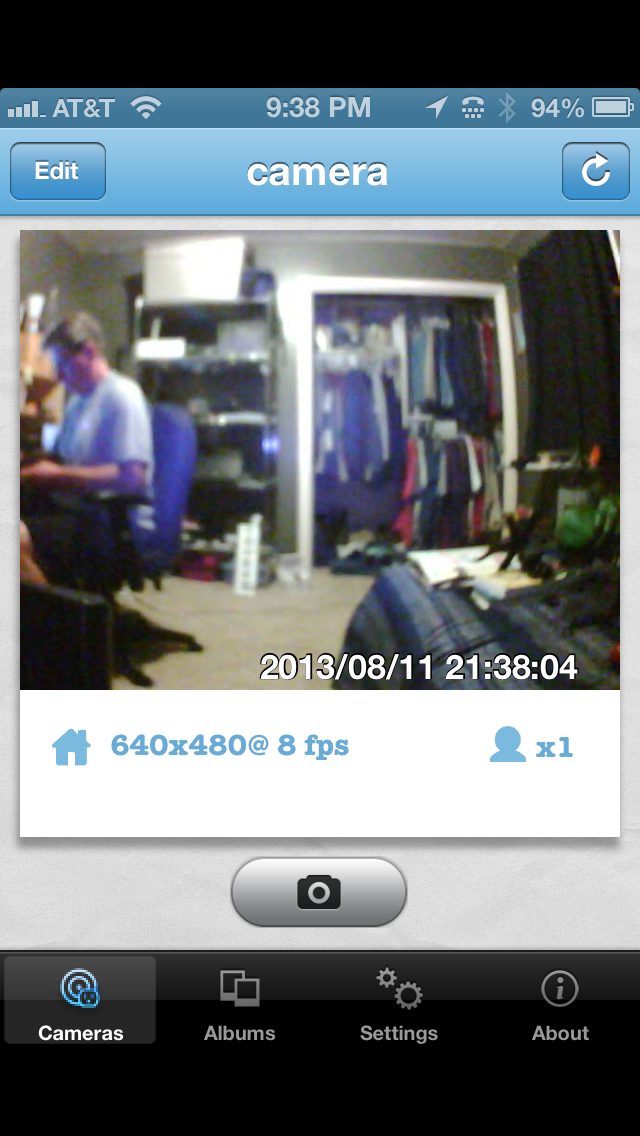
Figure 1: A live video view using the iPhone PlugnView app.
A local network search should find your camera within a few seconds. Once it does, you’ll see the cryptic identification code for your camera. Tap the found camera to edit its properties. Name your camera. I named mine “camera”. Leave the Camera ID as is. Enter the camera password from the bottom of the camera. Be careful to type it in exactly as you see it. Tap Save when done. Tap the Done button when your camera light in the app turns green.
Tap the camera that you just setup. You’ll see a “connecting to camera” message and then in a few seconds, you’ll see what the camera sees. You can also take pictures by tapping the camera icon on the screen. See Figure 1.
If you tap the Edit button (upper left corner), you can change the configuration of your camera, such as enhanced night vision, frame rate, resolution, and a few other details.
I suggest changing the frequency from 60Hz to 50Hz for better viewing inside your home. 60Hz probably works better outside. I also like the highest resolution and best quality picture available. You’ll have to experiment a bit for your surroundings and lighting conditions. Once you change something, tap the Apply button for it to take effect and then evaluate the results.
The PlugnView has pretty good resolution for the cost. Remember that this camera is not high definition video capable. It is what it is, which is an inexpensive, easy to setup, easy to use security camera. If you need something with higher resolution, sound, faster frame capture, and a panning camera, then you’ll have to spend a lot more money. For around $100, I doubt you’ll find anything better.
The PlugnView Home Monitoring Kit will keep you aware of what’s going on inside or outside your home. The PC software that you can download from DMM’s site is quite good. You can monitor multiple cameras at once with it but the app is a quick view used for occasional monitoring from your mobile device.
My overall impression and evaluation of the PlugnView Home Monitoring Kit is favorable. I like the ease of setup, the product quality, and the mobile app combination.
Why it’s frugal: The PlugnView is inexpensive but it’s more than price. If you need a decent quality home security camera, it fits that bill. You have night vision that is quite good, live video, snapshots, and good resolution. It is a good value and a good product.
Review: 8/10
Recommendation: Buy it with an understanding of its limitations and its features.

 Techopedia
- An error has occurred; the feed is probably down. Try again later.
Datamation
- Google and NextEra Strike AI-Powered Grid Deal
- NYT Sues Perplexity AI in Copyright Conflict
- Cloudflare Outage Affects Major Websites
- OpenAI Forces AI to Confess Its Lies
- OpenAI Declares Code Red as Google’s Gemini 3 Threatens ChatGPT
- Coupang Breach Exposes 33.7M South Koreans’ Data
- ChatGPT Celebrates Third Anniversary
- Asahi Group Reveals Findings of Cyberattack
- OpenAI Discloses Mixpanel Security Incident Affecting Some API Users
- Firefox Zero-Day Flaw Exposed 180M Users

 The Frugal Networker
You must be logged in to post a comment.