Archive
Diamond Multimedia Wireless Range Extender and Router WR300NR (Review)
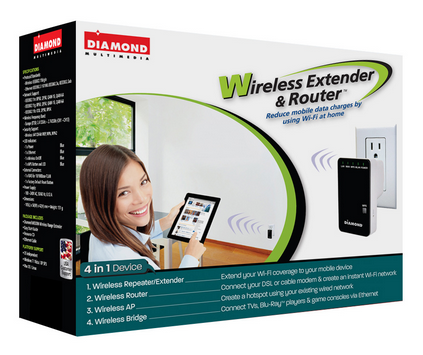 Wireless Extender and Router WR300NR
Wireless Router – Bridge – Repeater – Access Point
Diamond Multimedia
$49.99 Retail/$39.99 Amazon (Prime)
Product Spotlight Video
Diamond Multimedia offers a variety of wireless devices to extend your wireless networks, provide additional security to your wireless users, and to provide some advanced home networking features at a very low cost. The WR300NR (NR) is a sophisticated but inexpensive 4-in-1 wireless networking device. It can act as a router (default), a bridge, a wireless access point (hotspot), and a range extender. You can check out my review of a similar 3-in-1 product (range extender, bridge, wireless access point) from Diamond Multimedia–the WR300NSI Wireless Range Extender for comparison.
This review is not a comparison of the two products but rather a focus on the WR300NR’s router capability, which generally sets it apart from the WR300NSI.
The NR provides you with an extra layer of security as a router that you really need when using public Internet connections such as those in hotel rooms. You can read elsewhere about how non-secure public WiFi hotspots are. The NR protects you by adding a barrier or Firewall between you and the outside world.
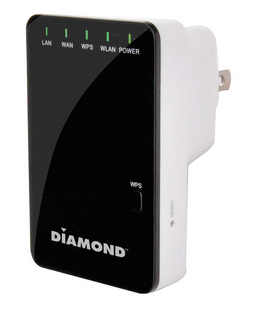 Setup is easy with the NR.
To start, plug in the device into any standard electric socket. Use the included RJ-45 network cable to plug into the LAN side of the device and the other end into the network card (NIC) in your laptop or desktop computer.
Restart the computer that’s connected to the NR or disable/enable the NIC to refresh its connection so that the NR supplies your computer with an IP address.
Open your favorite Internet browser application (Internet Explorer, Chrome, Firefox, etc.) and point it to http://192.168.10.253.
When prompted, enter admin for the username and admin for the password.
The initial screen opens for you. Note the navigation area on the left side of the screen. See Figure 1 for reference.

Figure 1: WR300NR Main Setup Screen
Use the included instruction booklet and the Wizard selection from the web page’s navigation menu to setup your NR. Router is the default setting. Click NEXT to continue.
If you’re setting up the NR to be your Internet gateway, then you’ll need to refer to your Internet provider’s documentation to tell you what kind of connection you have so that you can set your NR’s router mode: Fixed or Static IP Address, Dynamically assigned IP Address (DHCP), or an ADSL dialup (PPoE).
You can also setup your SSID, channel (Auto is fine), and security mode (Disabled, WPA, WPA2, or WPA/WPA2 mixed). I suggest WPA2.
NOTE: Do NOT leave your router in Disabled mode (default). Always use security on your home network so that passersby, neighbors, and criminals can’t piggyback onto your connection and potentially get you into trouble by downloading or uploading illegal files or participating in other illegal behavior at your expense.
That’s all there is to it. Basically one step with a few subparts. Click SAVE & REBOOT to save your settings and reboot the device.
For advanced users, there are many tweaks and settings to alter. You can configure the Firewall to meet your needs, change the Wireless settings, and edit just about every possible parameter.
Don’t worry about messing up or configuring yourself out of the device completely, since you can always reset the device to factory defaults by pressing the RESET button with an ink pen located on one side of the NR. Remember that if you do this, all of your changes will be gone. You will also have to reconnect to the device as described above by pointing your browser to http://192.168.10.253 and using username admin and password admin to return to the configuration screen.
Also, you’ll want to change the username and password for your router from the default. You don’t want to leave it as admin/admin. To change the username and password, click Management in the navigation pane. Why do this? Because if someone attempts to hack into your network, the first username and password combination he’ll try is admin/admin.
Remember to change the username and password if you travel and have to reset the NR. For $40, you could always buy two: One for home and one for travel.
The NR is a very capable router and firewall. For the money, it might be the best I’ve seen. There are many devices in this group from which to choose but none as small (2.9 x 1.9 x 1.6 inches), as feature-filled, or as competitively priced as the WR300NR.
Why it’s frugal: You could spend more for a larger device with the same or similar features and pay a lot (2-3X) more but why would you when the NR has everything you need? For $40 and free shipping from Amazon (For Prime members), it doesn’t make sense to buy anything else.
Rating: 9/10
Recommendation: Buy it. Use it at home and take it with you on the road.
IBM Flex-es its computing muscle again by going ‘Beyond Blades’
 This week IBM announced exciting news about new offerings within the Flex System. These offerings will help the system fully evolve into a high-performance, reliable, secure and cloud-based system that can be tailored to meet every SMB’s unique IT needs. Users will enjoy integrated computing, storage, networking resources that are both easy to use and adaptable to dynamic external conditions.
IBM’s new Flex systems go beyond blades to bring you truly integrated compute, storage, networking, and management into a modular and flexible system. It’s also the industry’s first 40GB bandwidths and integrated SAN.
What this means for SMBs is flexible, scalable, and customizable systems that can grow with business needs. The new modular Flex System is perfect for SMBs who are budget conscious in that this new Flex System provides more compute power per dollar than any comparable hardware on the market.
And IBM is going beyond blades in another way by designing its systems as ‘compute nodes’ and giving you the capability to support the equivalent of 28 compute nodes per IBM Flex System Enterprise Chassis.
“With a broad range of x86 and IBM POWER compute nodes, the Flex System V7000 storage node, enhanced networking capabilities and sophisticated system management capabilities, you can upgrade your existing blade server infrastructure and make your IT simpler, more flexible, more open, and more efficient.”
To learn more about IBM’s Flex System technology, watch the IBM Flex System video or connect to IBM’s Flex System page describing the technology and the new game changing improvements in detail.

This post was written as part of the IBM for Midsize Business program, which provides midsize businesses with the tools, expertise and solutions they need to become engines of a smarter planet.
I’ve been compensated to contribute to this program, but the opinions expressed in this post are my own and don’t necessarily represent IBM’s positions, strategies or opinions.
Overcoming the barriers of going global through cloud and mobile technologies
 In a previous post, “Transforming your company with cloud, mobile and MSPs“, I stated that these technologies level the playing field for companies wishing to break into a global marketplace. And it’s true, it does but barriers still exist, although the barriers are far lower than they were prior to the new “cloud revolution”. One of those barriers is expertise. Technology expertise, or the lack of that expertise actually, prevents many entrepreneurs and existing companies from taking that big global leap. There’s an excellent article by John Mason, General Manager, Midmarket Business, IBM, on this very topic titled, “When Small Businesses use Cloud and Mobile to Go Global.”
In the article, John describes the relationship between cloud and mobile technologies and how companies can harness these to launch their businesses on a global scale.
The problem that entrepreneurs face in their global business quest is that there is a clear disconnect between the technology and implementation of that technology towards a new market strategy. In other, more simple terms, there are no clear cut road maps to making that transition.
But it’s not all gloom and doom for the would-be global entrepreneur. Help is available.
In fact, John’s group at IBM can help with that. He speaks from a position of knowledge, authority, and history on the topic of global business and global opportunity. IBM, after all, since its official founding in 1911, was one of the first, if not the first, international (global) technology company. Additionally, it was also IBM that pioneered the technologies that we now refer to as “cloud computing”.
The underlying technologies might not interest you as a business owner or global business entrepreneur but what you need to know is that to overcome the remaining barriers to global business, you need a company, and its partners, behind you that blazed the global business trail.
But how can cloud computing and mobile technologies help launch your business into the global business arena?
John gives multiple examples in his article of how it works. For example, he states, “More and more small farmers are today harnessing the power of mobile to help them connect to agricultural services, information and markets. With a few taps, farmers in remote areas can obtain information about the optimum time to plant their seeds, the right way to keep pests at bay, or the best market in which to sell their crops.”
The keywords in his example are, “the best market in which to sell their crops.” What is the best market? Domestic? Foreign? If it’s foreign, the farmer has to connect to those markets. He has to schedule delivery, negotiate pricing, and then deliver the crops. How does a small farmer make that transition?
The answer is technology.
To overcome the barriers, you have to engage expertise that you don’t have. You have to find someone who’s been there and done that. And you have to find someone who’s done it many times before–successfully.
Moving to a global marketplace has never been easier but there are still barriers. You need a partner who knows the way.
This post was written as part of the IBM for Midsize Business program, which provides midsize businesses with the tools, expertise and solutions they need to become engines of a smarter planet.
I’ve been compensated to contribute to this program, but the opinions expressed in this post are my own and don’t necessarily represent IBM’s positions, strategies or opinions.
Transforming your company with cloud, mobile and MSPs
 I just watched a video where IBM and two IBM partners discuss Managed Service Providers (MSPs), cloud, mobile, and transforming your business with technology. The video is part of a new IBM series targeting SMBs and demonstrating how cloud, mobile, and their MSP partners can transform or launch your business for very little money. They call the series Coffee and Conversation. It’s a casual and relaxed conversation over coffee about technological transformation. The two companies represented in this first video are CloudView and WakaDigital.
The message of the video is clear: MSPs can help transform or launch your business for little money and give you the global exposure and agility required to succeed in today’s market.
It sounds simple and it is simple.
Personally, if I were to launch a new business today, I would not lease office space. I wouldn’t buy or even lease a bunch of hardware for my own server room. I certainly wouldn’t go into massive and crushing debt to acquire the hardware, software, support staff, maintenance contracts, and the myriad of costly services and personnel required to run the business.
I would work out of my home, comfortably in my home office, and use an MSP and cloud technologies to empower me to:
- Appear as a larger company.
- Quickly spin up a usable computing infrastructure.
- Enable my customers to interact with me via mobile and cloud technologies.
- Allow customers to purchase my products and services securely online.
- Be everywhere at once.
Now I know that sounds far-fetched but it isn’t. Finding the right business partners is essential to your success. Your MSP is your business partner. It provides everything you need to run your business from a technology perspective.
All you have to worry about is how to manage your supply chain, contingent workers, and accounting. But guess what? IBM has a solution for all of those problems too. Their partners cover the gamut of every needed service and possible line of support that you need.
As Leila Ashley (CloudView) says in the video, this new agile business model “levels the playing field” for SMBs who need to compete with hungry start-ups, as well as, established, well-funded enterprises. Ms. Ashley goes on to zero in on an important aspect of this new business model by stating that they can launch an e-commerce site in a day’s time instead of a week. What she’s telling you is that you can effectively have an idea at 8AM and realize that dream by 5PM the same day.
You don’t have to wait for proof of concepts, ordering new hardware, procuring software, installing, patching, and updating any operating systems or applications. You have an agile, automated solution waiting for you with very few obstacles and very low entry barriers.
Business is different today than it was even ten years ago. Cloud technologies and agile systems allow us to respond to changing business needs, to test new products and new markets without a heavy capital investment, and without long delays. We can now respond within the windows of opportunity that present themselves to us. That is true agility.
And what about businesses that can’t make the transition?
Denise Garth (IBM) makes an excellent point in the video by observing that businesses either will transform or possibly become irrelevant.
Forty years ago, you weren’t relevant if you didn’t have a Yellow Pages ad. Ten years ago, you weren’t relevant if you didn’t have a website. Today and tomorrow, you might become irrelevant if you can’t meet the challenges of a transformed business. Sure, some might say that business is business and people don’t change but, on the other hand, technology has transformed the customer into a technologically-connected buyer. That’s relevant to any business.
Businesses must transform to meet the needs of the new customer paradigm. Online, agile, cloud-oriented, connected, mobile, and social media-savvy is the new business paradigm.
IBM’s MSP partners can help you transform your business. Level the playing field by contacting IBM and its partners and go have a cup of coffee.
While you’re sipping on that hot cup of bean juice, take a look at how other companies just like yours are being transformed.
This post was written as part of the IBM for Midsize Business program, which provides midsize businesses with the tools, expertise and solutions they need to become engines of a smarter planet.
I’ve been compensated to contribute to this program, but the opinions expressed in this post are my own and don’t necessarily represent IBM’s positions, strategies or opinions.
Leveraging Next-Generation MSPs for Agile Business Strategies
 Managed Service Providers (MSPs) have taken on a whole new role in the IT service and support business—that of the Agile Business Enabler. And this moniker isn’t just another marketing buzzterm, it’s a real thing. Since Chuck Calio has told us What a next-generation MSP looks like and Timothy Tsao has told us not only what a next-generation MSP looks like but also how it acts, I’ve decided to focus on one particular aspect (#4) of Timothy’s described actions—agility.
In my opinion, agility is the most important “action” that an MSP can take to increase its business by enabling its customers to become more responsive to marketing campaigns, to changing business needs, and to the needs of its customer’s customers.
Business agility is the ability of a business to respond to, to act on, and to predict business trends. Whether those trends are driven by new technologies, by the latest fad, or by the season; businesses need to respond quickly and decisively to these changes. The role of the MSP is to enable their customers to do this seamlessly and without intervention.

Become a Next-Generation MSP at Edge 2013
The best strategy for MSPs to enable businesses to become agile is to create customer portals that allow for automated infrastructure management. Many MSPs already have such portals in place but perhaps the missing link is the scalability of the solutions offered to customers.
As Timothy Tsao suggests, one way to offer agile solutions is to invest in next-generation systems and storage that allow customers to “spin up client applications and new services in minutes, not days.”
That single term, “investment” is the most important one in that sentence. As both Tsao and Calio state, cloud services are trending toward commoditization. Investment in next generation technologies requires capital expenditure, which means a lag time between that investment and its financial return. This situation often results in a fiscal Catch 22. You can’t invest until you have the business justification for it and you can’t acquire new business until you’ve made the investment.
I believe that MSPs must take the risk and invest in a “Field of Dreams” approach to acquiring new business and enhancing services for current customers.
The way MSPs become next-generation MSPs is through investment and through this new agility-enabled approach to their customer’s businesses. In other words, for MSPs to realize a next-generation shift, they must focus on their customer’s businesses and their customer’s customers. That, in part, is how I define “next generation.” The MSP must not only invest in new technology but also must focus on that next generation of customers.
See Also:
IBM Offers $4 Billion in SMB Financing
This post was written as part of the IBM for Midsize Business program, which provides midsize businesses with the tools, expertise and solutions they need to become engines of a smarter planet.
I’ve been compensated to contribute to this program, but the opinions expressed in this post are my own and don’t necessarily represent IBM’s positions, strategies or opinions.
IBM’s New Power Systems Bring Affordable Power to SMBs
 Before IBM announced its eight new Power Systems, big data solutions and cloud computing solutions were only available to enterprise-level customers. These eight new Power Systems, three new PureSystems models and new Storage Systems technologies bring high-powered but cost-effective results to small and medium-sized businesses (SMBs). At an entry-level price that’s under $6,000 USD and reseller agreements with TechData and Ingram Micro, IBM puts big computing power at standard x86 pricing into the hands of small business owners.
This “resurfacing” of IBM’s Power Systems allows SMBs to remove the complex nature of developing cloud-based services and applications by making it easier to provision, deploy and manage a secure cloud environment.
Implications for Big Data
Analytics that once seemed out of reach for SMBs are now possible with IBM Netezza Analytics. These new PureData Systems for Analytics, powered by Netezza technlogy, are optimized for big data applications and feature 50 percent greater data capacity per rack and the capability of analyzing data up to three times faster than earlier versions of PureData Systems for Analytics.
“IBM Netezza Analytics is an embedded, purpose-built, advanced analytics platform — delivered with every IBM Netezza appliance — that empowers analytic enterprises to meet and exceed their business demands.”
IBM Netezza Analytics’ is a fusion of data warehousing and in-database analytics. The result is a scalable, high-performance, massively parallel advanced analytic platform that is designed to crunch through petascale data volumes. This allows users to query the data that are only imagined on other architectures. IBM Netezza Analytics design provides better and faster answers to the most sophisticated business questions.
With IBM’s Netezza Analytics and new PureData System for Analytics, you can leverage the power and clarity of big data analytics without the huge cost layout associated with enterprise-level technology.
Accelerating Cloud Computing Adoption
Cloud computing doesn’t have to be painful or expensive. The smaller PureApplication System offers companies with limited budgets and technical resources a “cloud in a box” solution. All the infrastructure and management software required to develop and deploy new on-premise cloud are included to remove the complexity, the time and the labor usually associated with cloud migration projects. And there’s no performance sacrifice with these smaller configurations, so don’t assume that you’re getting less just because you’re paying less and dealing with less hassle.
One of the pudding proofs of this high performance, low cost and minimal hassle assertion is IBM’s Managed Service Provider (MSP) client market segment. MSPs assist SMBs solve complex technical problems. To grow their own businesses, MSPs must expand their IT infrastructures and service delivery capabilities and minimize disruptions and risks associated with business growth. IBM offers services and infrastructure solutions designed specifically for MSPs including new MSP Editions, flexible “pay as you grow” financing options, and enhanced marketing and sales support. These offerings empower MSPs to deliver cloud infrastructures that enable them to drive new revenue streams.
IBM’s new offerings for SMBs include:
- Smaller PureApplication System
- PureApplication System on POWER7+
- Expanded Software Patterns Catalogue
- MSP Editions for PureFlex System and Flex Systems
- SmartCloud Desktop Infrastructure
“PureSystems is part of IBM SmartCloud offerings, a portfolio of enterprise-class cloud computing technologies and services built on open standards that provides flexible deployment options including PureSystems and IBM SmartCloud services. IBM helps clients build private clouds with IBM SmartCloud Foundation, which provides a common cloud operating environment across the different deployment options. IBM SmartCloud helps clients quickly build and scale private clouds and hybrid clouds for cloud capabilities such as Infrastructure-as-a-Service and Platform-as-a-Service.”
IBM’s new product offerings focus on small to medium-sized business needs in a way that no other vendor does. IBM and its partners continue to innovate to make your business more efficient and more profitable to operate. And if you need expertise to get it done, IBM and its partners are there to support you.
Big data analytics and cloud computing are but two of the hundreds of services and platforms available to meet your needs.
Read more about IBM Analytics, Data warehouse products and Cloud computing solutions. Download the Cloud Computing for Dummies ebook and find out how cloud computing can transform your business.
IBM’s Global Financing offers flexible and affordable financing to acquire the technology you need to expand and extend your business.

This post was written as part of the IBM for Midsize Business program, which provides midsize businesses with the tools, expertise and solutions they need to become engines of a smarter planet.
I’ve been compensated to contribute to this program, but the opinions expressed in this post are my own and don’t necessarily represent IBM’s positions, strategies or opinions.
Virtualization Tips: Insights from Virtualization Experts
 Virtualization is a move in the right direction for many reasons: service rightsizing, consolidation, cloud computing, agile solutions, better hardware utilization, XaaS and modernization. The migration from a purely hardware-driven data center to a more virtualized one can seem daunting. To add confusion, there are several options from which to choose in the virtualization market. And although some industry experts would argue, there’s no single correct answer to every problem.
If you’re considering moving toward a virtualized infrastructure, there are some things that you should know first. For example, server and service consolidation projects usually precede virtualization projects. You already have too many servers doing too little, so you don’t want to simply convert that inefficient environment to a virtual one. You won’t gain the savings that you deserve, if you do.
IBM has created a Virtualization Tips infographic that you can view or download for reference. This infographic contains valuable tips and advice from leading industry experts. The infographic includes the four primary steps toward realizing your own virtual infrastructure: prepare, plan, extend and implement.
The infographic also includes survey results and statistics from more than 2,000 industry decision makers.
IBM also offers you the code to embed the infographic on your website.
Dan Kusnetsky’s eBook promotion is on the IBM MM Facebook page: http://goo.gl/yZmY3. Please note that for the eBook promotion, users can only receive the download if they are a fan of IBM for Midsize Businesses on Facebook.
This post was written as part of the IBM for Midsize Business program, which provides midsize businesses with the tools, expertise and solutions they need to become engines of a smarter planet.
I’ve been compensated to contribute to this program, but the opinions expressed in this post are my own and don’t necessarily represent IBM’s positions, strategies or opinions.
CBTNuggets PowerShell 3 Foundations with Don Jones (podcast)
Ready to learn Windows PowerShell? Learn from the best: Microsoft MVP award recipient Don Jones, author of “Learn Windows PowerShell 3 in a Month of Lunches,” presents a video training series that will help you master PowerShell’s foundations with absolutely zero prior experience.
Using a friendly, approachable style and a carefully planned outline, Don introduces you to PowerShell’s ins and outs, one piece at a time. With a focus on teaching you how to use PowerShell to actually teach yourself, you’ll become “immediately effective” in just a few short lessons, and start exploring some of PowerShell’s high-end capabilities. Full of clear demonstrations and advice for avoiding the most common pitfalls and “gotchas,” this is the perfect way to learn Microsoft’s new command-line and scripting technology.
PowerShell 3 Foundations on CBTNuggets.com.
Podcast Details: Length: 26:58 mins. Format: MP3. Rated: G, for all audiences.
Podcast: PowerShell_3_Don_Jones_CBTNuggets
Technology Trends for SMBs: 2013 Outlook with Ed Abrams (Podcast)
 Podcast with Ed Abrams, IBM‘s VP of Marketing and Strategy for Small and Medium-sized businesses (SMBs).
By 2017, the CMO will Spend More on IT Than the CIO, according to Gartner. With that in mind, small and midsize businesses (SMBs) are evaluating strategies for business success, keeping in mind that new technologies and marketing trends are likely to take center stage in the coming year.
In the podcast, Ed and I discuss how SMBs can better understand the individual consumer, how SMBs are leveraging mobile and cloud technologies in order to unfold new business opportunities, how new technologies are helping SMBs provide better customer analysis to help grow business, some best practices for SMBs to more effectively manage a more global and remote workforce to increase overall productivity and the top challenges SMBs face today as the consumer purchasing patterns change.
Ed_Abrams_IBM_SMB_Business_Trends_04_Jan_2013
Podcast Info: Length: 19:48 mins. Format: MP3. Rated G for all audiences.
This post was written as part of the IBM for Midsize Business program, which provides midsize businesses with the tools, expertise and solutions they need to become engines of a smarter planet.
IBM Offers $4 Billion in SMB Financing and a New Mobile Credit App
IBM recently announced that it is providing its ecosystem of business partners with $4 billion in financing for credit-qualified clients over a period of 12 months. This financing, available through IBM Global Financing, can make obtaining credit easier and more accessible to enable IBM’s Business Partners and their clients to acquire technologies such as cloud, analytics and PureSystems.

The U.S. Small Business Administration (SBA) consistently reports that well over 50 percent of small businesses fail within their first five years due to lack of capital. Since this segment is responsible for nearly 65 percent of global GDP, representing more than 90 percent of all businesses and employing more than 90 percent of the world’s workforce, SMBs play a critical role in a global economic recovery.
Financing is one of the biggest challenges limiting the success of SMBs today.
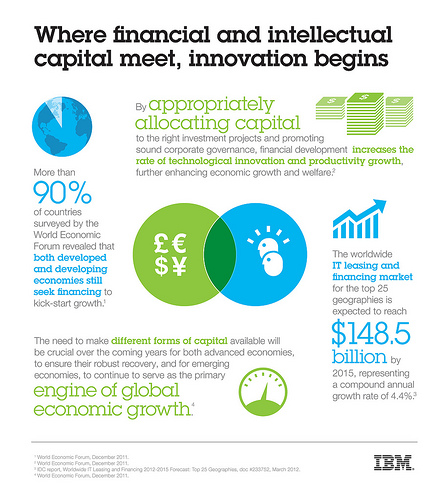
Clients can now take advantage of these new technologies with no money down and by simply making monthly or quarterly financing payments. For example, many of the offerings are less than $5 per user per month (over 36 months) for 100 users. In addition, these technologies can now be up and running in a matter of two to three days, saving SMBs up to 50 percent in cost and time.
The new solutions also include analytics for SMBs to tackle “Big Data” challenges to help better extract insight and spot trends to make better business decisions and identify new market opportunities. These offerings will combine technologies from IBM’s recent acquisitions. In fact, the survey highlighted analytics as the top priority by more than 83 percent of CIOs.
IBM is also launching a new mobile app as another step to simplify the way IBM’s Business Partners can apply for financing and gain access to credit within minutes via any mobile device.
IBM Global Financing can provide credit qualified clients access to the capital you need to quickly and affordably move to IBM. Working with IBM can simplify the process and provide you a financing structure that helps you preserve cash, improve your financial return and mitigate risk.
This post was written as part of the IBM for Midsize Business program, which provides midsize businesses with the tools, expertise and solutions they need to become engines of a smarter planet.

 Techopedia
- An error has occurred; the feed is probably down. Try again later.
Datamation
- USA₮ Modernizes American Payments with High-Impact St. Patrick’s Day Activation in Times Square
- Google and NextEra Strike AI-Powered Grid Deal
- NYT Sues Perplexity AI in Copyright Conflict
- Cloudflare Outage Affects Major Websites
- OpenAI Forces AI to Confess Its Lies
- OpenAI Declares Code Red as Google’s Gemini 3 Threatens ChatGPT
- Coupang Breach Exposes 33.7M South Koreans’ Data
- ChatGPT Celebrates Third Anniversary
- Asahi Group Reveals Findings of Cyberattack
- OpenAI Discloses Mixpanel Security Incident Affecting Some API Users

 The Frugal Networker
You must be logged in to post a comment.